
The Anatomy of a Perfect Sweater
CBK Project Part II

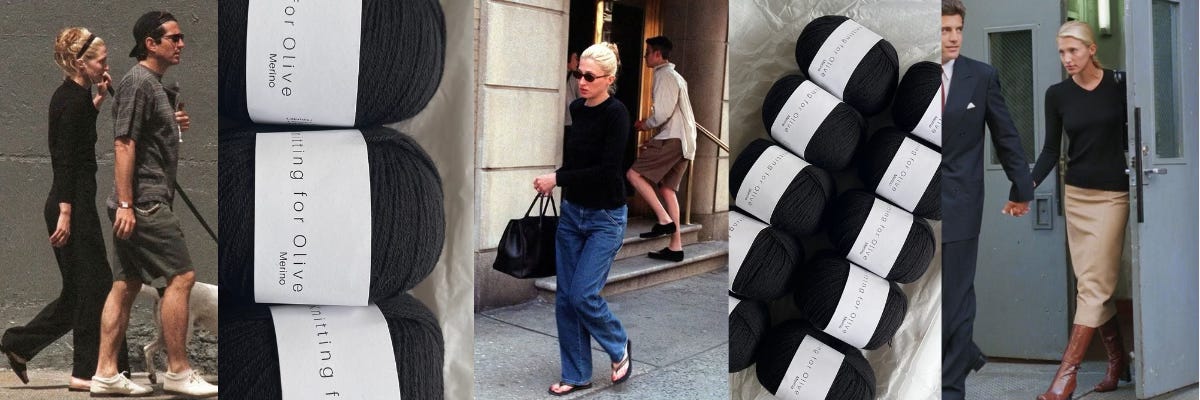
Three key elements separate a decent sweater from a great one - fabric, fit and fibre content. Individually, they’re important but together, they can create a garment that’s beautiful, functional and timeless.
This combined effect is the motivation behind the CBK Project.
Carolyn Bessette Kennedy is celebrated for her minimalist approach to everyday styling. Whether her style was a symptom of her surroundings, an effort to remain out of the limelight, or simply personal preference is a topic of much debate.
Without certainty on her motivation, all I can say is this: her approach to simple styling remains relevant and inspiring today. However: great, minimalist style is impossible without incredible basics.
I’m talking well-made, well-cut, well-fitting pieces that can be reworn beyond a single season or trend cycle. This is what I’m inspired to emulate in my self-drafted CBK sweater.
How will I do it, though?
Well, let’s break down the anatomy of a great sweater.
Fabric
Drape and ease are both words we hear a lot as knitters. The intersection of the two creates a specific look and feel. A structured fabric with no ease makes for a stiff and fitted garment whereas a flow-y fabric with lots of positive ease creates an entirely different vibe.
In this case, I am looking for some flexibility (drape) in the fabric, but not so much that the garment doesn’t hold its shape. I want the gauge to be dense enough to create an opaque fabric, but not so dense that it becomes heavy or stiff.
For this project, I want a closer fit than I typically knit - usually, I go for very oversized garments with around 25-30cm of positive ease - so an ease between 5 and 10 cm sounds right.
Fit
Fit is informed by three distinct elements. First, your body measurements. Second, what’s in style and therefore available to buy/make. Third, personal preference.
For this project, fit is yet another area where I’m drawing inspiration from CBK.
Let me explain.
The images I’ve gathered on my project mood board share some commonalities. They feature sweaters are all slightly fitted, hip length, with wrist-grazing, tapered sleeves.
Each of these elements will be incorporated into my final design. The aim here is to ensure I will make a sweater that is timeless and versatile in my wardrobe. I hope to be able to use it repeatedly in various outfits - à la Carolyn Bessette.
Fibre
The final element in my three-pronged approach to building the perfect sweater is fibre.
As knitters, we have the luxury of selecting the materials that we work with. A fact I plan to take advantage of here.
Since I’m drawing so much inspiration from CBK, I have to note the fact that she had access to amazing designer garments that made use of beautiful and luxurious fabrics.
While it isn’t in my budget to use 100% cashmere for this sweater, I wanted to keep fibre content front of mind in my planning.
Ultimately, I decided to select a natural fibre that would wear well and feel great - something I think is evocative of CBK’s own pieces.
I chose 100% merino wool from Knitting for Olive because the yarn is lovely to work with, wears well and their transparent sourcing and sustainable practices align with my values.
So, there you have it. My take on the anatomy of a great sweater. Now, all that’s left to do is make one!
I’d love to hear your thoughts on this - did I miss anything? Sound off in the comments!